

LARGE AIRCRAFT
General overview of one analysis case for production
General Overview
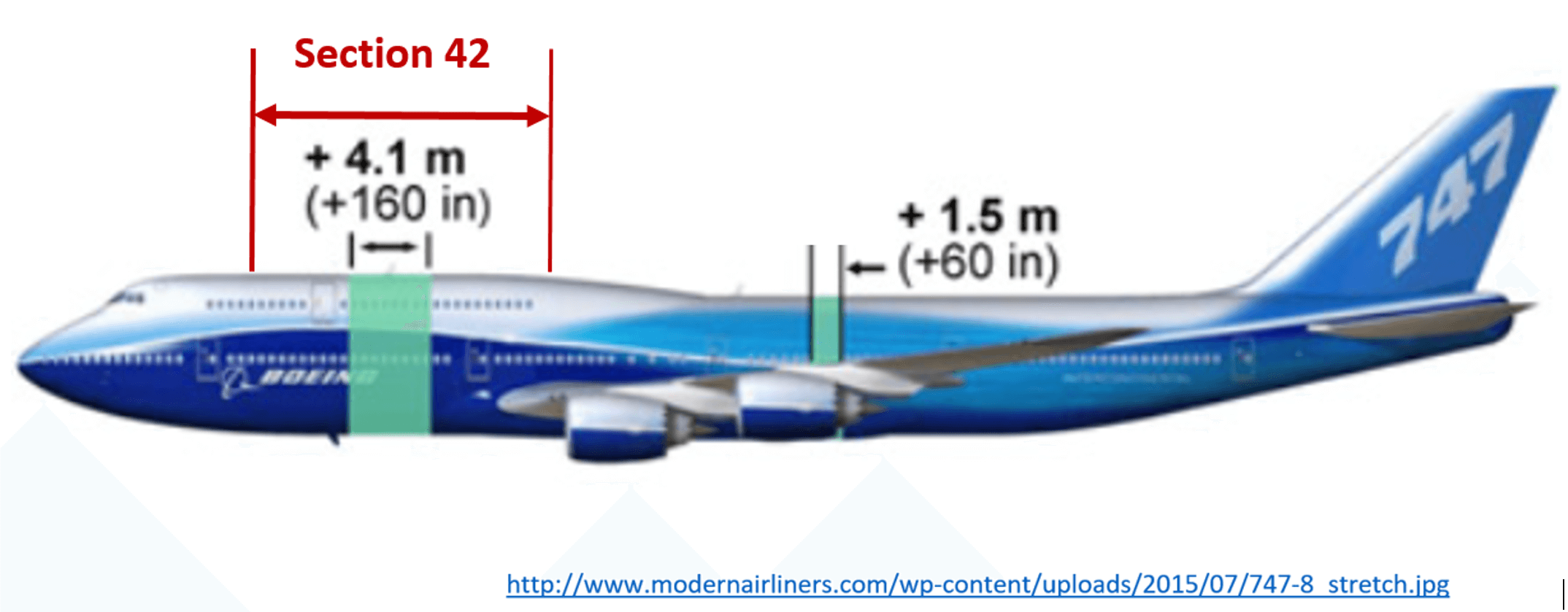
For the last generation of the 747 transport aircraft, the fuselage was increased by 220"(5.6m), with 160" in Section 42, and 60" aft of the wing in Section 46. As result of the increased fuselage bending loads, initiation and propagation of fatigue, cracks growing from the corners of the second door needed assessment and preventative measures that accounted for the several missions profiles of this aircraft.
The sizing of the aircraft was based on a "Loads Model" containing the average loads in a bay-by-bay arrangement, with a bay generally being defined as the space between two consecutive frames and two adjacent stringers, or at the middle of the uni-dimensional elements (frame caps and stringers).
With dimensions of Door 2 being approximately 54" wide and 82"high, at full-scale, the deformations of the door edges were assessed through thin markers (0.001in² sections and of small stiffness).
For the fatigue relevant loading situations—defined by over 400 primary external load scenarios, including ground operations, initial and final climbs, gust and manoeuvres, and the descent portions of the flight—localised stresses were required at the corners of the door and at the fastener holes. Fastener loads were also required.
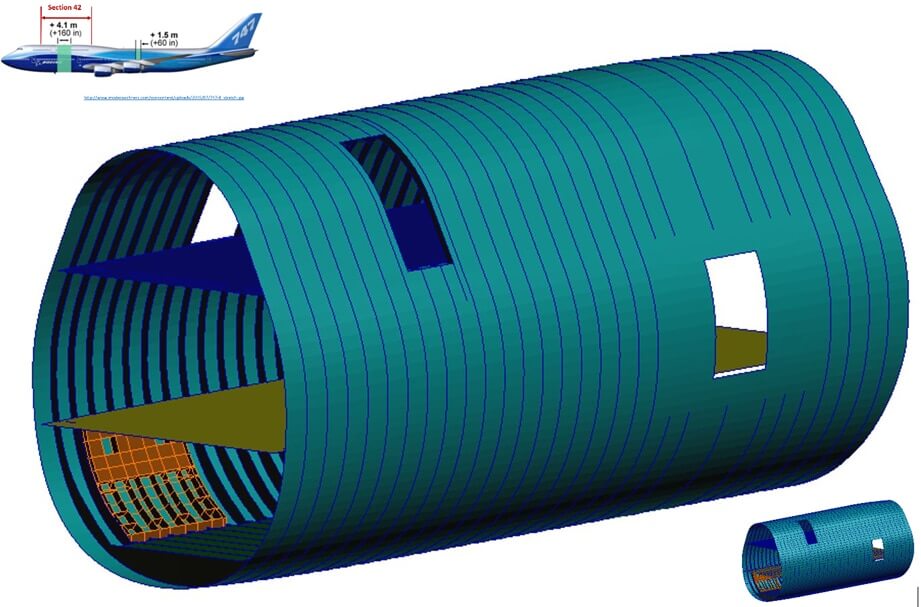
Section 42 Superelement (stringers & floor beams not shown)
Top corner: Location of Section 42 and added plugs – click side image to enlarge.
Lower corner: Overview of layout for fuselage reinforcing elements and floor beam arrangement.
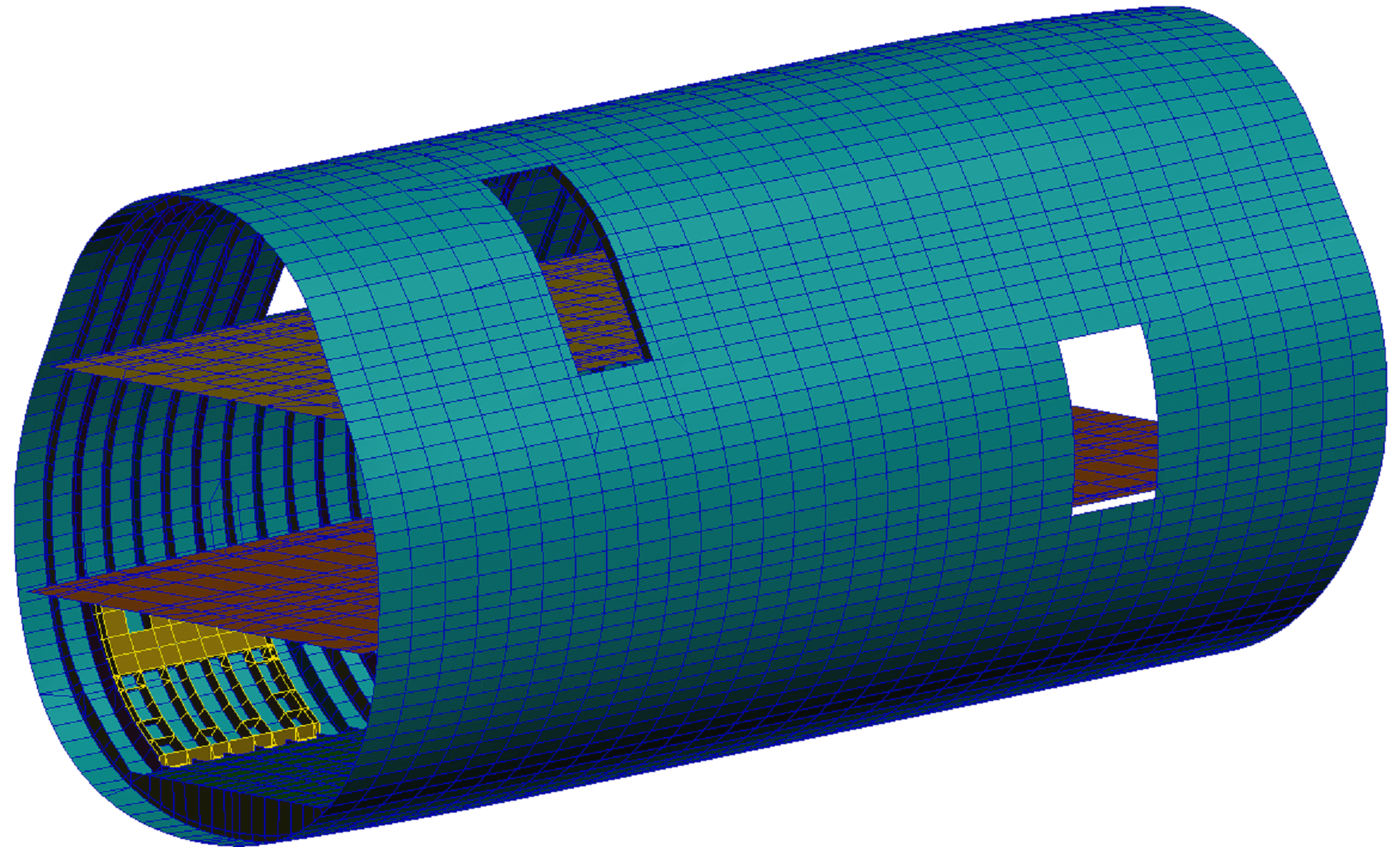
From Global Loads to Local Stresses
In order to estimate the edge stresses at the corners of aircraft doors, a more detailed model of the door area was generated. Several parts, which were incorporated into the skins or frames in the global model, needed to be represented explicitly—due to some parts being wedged between others—where cracks are difficult to notice during visual or dye-penetrant inspections.
All the newly detailed parts were positioned at the layer of adjacent fuselage skins and the connecting fasteners were modelled with zero-length CBUSH elements.
In order to determine the stresses on the door edges, thin bar elements were added between consecutive nodes along each edge. The material properties of these bars were identical with that of the adjoining skins. Depending on location, the length of these elements varied between 0.05 and 0.2 inch. A similar approach was used for other internal parts ending at, or near to, the edges of the door cut-out.
In this new discretisation, the sub-model was solved using MSC Nastran Solution 101 for all fatigue-relevant load cases, and deformations at the door markers were compared against their values in baseline configuration to ensure that any differences were within acceptable limits. Next, the stress data from the bar elements was processed in order to generate the the fatigue stress spectra for the critical mission profile of different locations, and the fatigue strength at the cut-out was conducted using Boeing's methods and bespoke software. The specific methodology details used during post-processing are proprietary information of the Boeing Commercial Aircraft company.
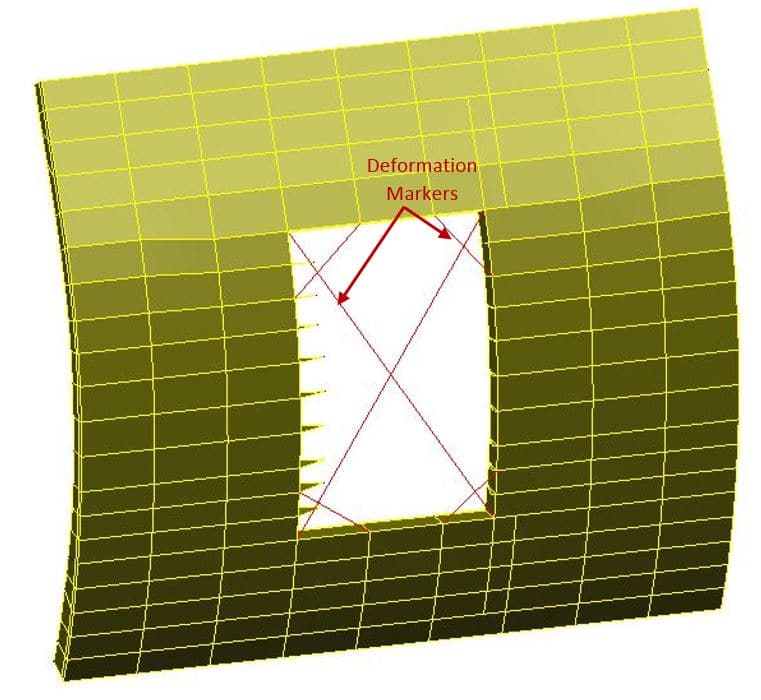
Door 2 area in baseline configuration
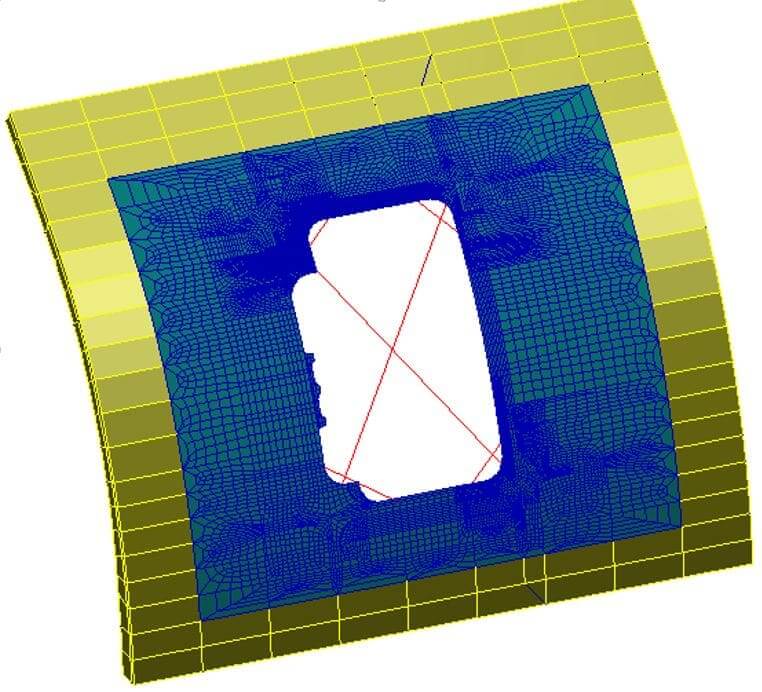
Same area with refined discretization
